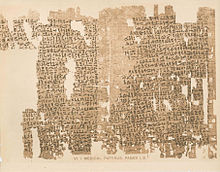
The Kahun Gynaecological Papyrus (also Petrie Medical Papyrus, Kahun Medical Papyrus, Lahun Medical Papyrus, or UC32057) is the oldest known medical text in Egypt,[citation needed] although not the oldest in the world as in Philadelphia museum a Sumerian medical clay tablet from 3rd millennium is preserved.[1] Dated to c. 1800 BCE, it deals with women's health—gynaecological diseases, fertility, pregnancy, contraception, etc.

History
It was found at El-Lahun (Faiyum, Egypt) by Flinders Petrie in 1889[2] and first translated by F. Ll. Griffith in 1893 and published in The Petrie Papyri: Hieratic Papyri from Kahun and Gurob.[3] It is kept in the Petrie Museum of Egyptian Archaeology of the University College London. The later Berlin Papyrus and the Ramesseum Papyrus IV cover much of the same ground, often giving identical prescriptions.[4]
The text is divided into thirty-four sections, each section dealing with a specific problem and containing diagnosis and treatment; no prognosis is suggested. Treatments are non-surgical, comprising applying medicines to the affected body part or swallowing them. The womb is at times seen as the source of complaints manifesting themselves in other body parts, for which its fumigation is recommended, either by oils and incense or whatever the woman smells roasting, should it cause her to smell roasting.
| This article uses material from the Wikipedia article Metasyntactic variable, which is released under the Creative Commons Attribution-ShareAlike 3.0 Unported License. |